Daraxonrasib Nearly Doubles Survival in Pancreatic Cancer
Daraxonrasib, also known as RMC-6236, nearly doubled survival in a phase 3 metastatic pancreatic cancer trial, but it remains experimental.
The Headline Finding
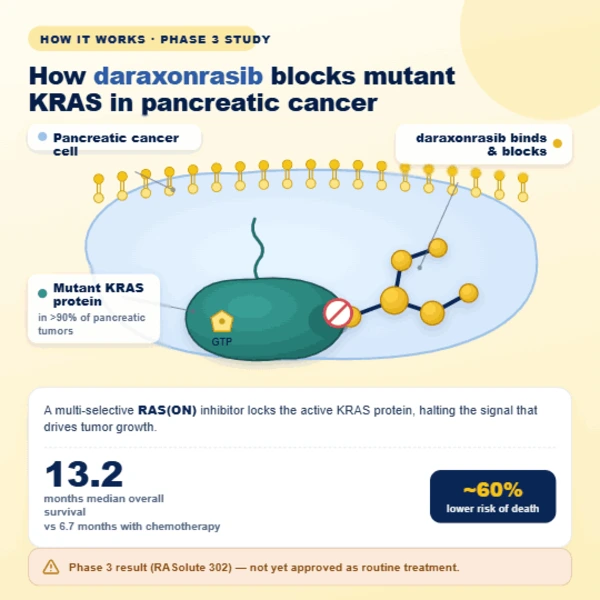
The central finding is now clearer after the May 31, 2026 ASCO plenary presentation: daraxonrasib, also known as RMC-6236, nearly doubled median overall survival in previously treated metastatic pancreatic ductal adenocarcinoma (PDAC). In the phase 3 RASolute 302 trial, patients receiving the once-daily oral RAS(ON) inhibitor lived a median of 13.2 months, compared with 6.7 months for investigator's choice chemotherapy. The result corresponds to a 60% reduction in the risk of death.
The important practical point is that this is a major late-stage clinical-trial result, not yet routine approved treatment. The FDA has authorized an expanded access pathway for eligible patients, but expanded access is different from full drug approval.
Why This Matters
Pancreatic cancer remains one of the deadliest malignancies in the world. Five-year survival sits below 13% across all stages and collapses to roughly 3% for metastatic disease. Most patients are diagnosed too late for curative surgery, and treatment options have advanced only incrementally over the past two decades.
At the molecular level, the KRAS gene has long defined the problem. Mutations in KRAS are present in more than 90% of pancreatic tumors and drive uncontrolled cell division. For four decades, KRAS was described as undruggable: the protein's smooth surface offered no binding pocket where a drug molecule could attach. Earlier KRAS-targeted drugs such as sotorasib work only against a single mutation variant (KRAS G12C) that is rare in pancreatic disease.
Daraxonrasib is different. It belongs to a new class called RAS(ON) multi-selective inhibitors, designed to block the active GTP-bound form of RAS proteins across multiple mutation subtypes. That mechanism is the reason researchers describe the RASolute 302 data as transformative for an entire patient population, not a narrow subset.
Inside the Study
RASolute 302 (NCT06625320) was a global, randomized, controlled phase 3 trial sponsored by Revolution Medicines, a late-stage clinical oncology company based in Redwood City, California. Approximately 500 patients with metastatic PDAC who had progressed on at least one prior line of systemic therapy were randomly assigned to receive either daraxonrasib 300 mg orally once daily or investigator's choice of standard second-line intravenous chemotherapy.
The trial was led by Brian M. Wolpin, MD, MPH, at Dana-Farber Cancer Institute, with Eileen M. O'Reilly, MD, of Memorial Sloan Kettering serving as co-investigator and lead author on the NEJM publication. Dual primary endpoints were progression-free survival and overall survival. Both endpoints reached statistical significance at the first interim analysis announced April 13, 2026, and Revolution Medicines indicated the results are considered final.
Key Findings
- Median overall survival: 13.2 months with daraxonrasib vs 6.7 months with chemotherapy
- Hazard ratio for death: 0.40 (p < 0.0001), a 60% reduction in risk of death
- Progression-free survival also met its primary endpoint
- Benefit observed across all RAS mutation subtypes (G12D, G12V, G12R, and others)
- Phase 1/2 data: 30% objective response rate at 300 mg, 90% disease control overall
- Median duration of response in phase 1/2: more than 8 months
- Safety: 96% any-grade treatment-related events; 30% grade 3 or higher
- No new safety signals identified in phase 3
What the Researchers Are Saying
"In this pivotal trial, daraxonrasib as a targeted medicine delivered a dramatic improvement in overall survival in patients with previously treated metastatic pancreatic cancer compared to standard of care chemotherapy, consistent with earlier findings. These results represent a potentially transformative advance for patients," said Brian M. Wolpin, MD, MPH, principal investigator and director of the Hale Family Center for Pancreatic Cancer Research at Dana-Farber Cancer Institute.
"This is the first RAS inhibitor evaluated in a large, randomized trial for patients with pancreatic cancer, and it demonstrates how important an impact these novel medicines are likely to have on the treatment of the disease," Dr. Wolpin added.
"This is happening across a broad selection of patients because KRAS mutations are present in nearly every pancreatic cancer case and are important to the growth and metastasis of this disease. It's very encouraging that we are seeing these kinds of results for people with pancreas cancer on a large scale," said Eileen M. O'Reilly, MD, gastrointestinal oncologist at Memorial Sloan Kettering Cancer Center and lead author of the NEJM paper.
Caveats and Limitations
Several caveats should stay close to the headline.
First, daraxonrasib is still investigational. Expanded access in the United States allows some eligible patients to receive the drug before formal approval, but it does not mean the medicine is FDA approved for routine commercial use.
Second, the trial was conducted in previously treated metastatic PDAC. The data should not be overextended to first-line therapy, locally advanced disease, or curative-intent treatment until dedicated studies report results.
Third, side effects remain clinically important. Rash was common, although reports from the ASCO dataset describe it as generally manageable. Serious adverse events were reported less often than with chemotherapy, but patients still need oncologist supervision and careful monitoring.
Fourth, the evidence is strong but still developing. The ASCO presentation, company data, independent news coverage, and oncology reporting all point in the same direction, yet regulators still need to review the full package before deciding on approval.
What Happens Next
The next phase is no longer about waiting for the ASCO presentation; it is about regulatory review, access, and confirmation in broader practice.
May 31, 2026: The full RASolute 302 dataset was presented at the ASCO Annual Meeting, strengthening the public evidence base beyond the April topline announcement.
Current access: The FDA-authorized expanded access program may allow eligible U.S. patients with previously treated metastatic PDAC to receive daraxonrasib through their treating oncologist before formal approval.
Regulatory path: Revolution Medicines has said it plans to submit a New Drug Application to the FDA, with additional global regulatory steps expected afterward.
Research path: Trials in earlier treatment lines, combination regimens, and other RAS-driven cancers will determine whether the benefit can expand beyond second-line metastatic pancreatic cancer.
The Bigger Picture
Daraxonrasib is part of a broader scientific wave often called the "RAS revolution." For four decades, KRAS was considered undruggable. The 2021 approval of sotorasib for KRAS G12C-mutant lung cancer cracked that ceiling but addressed only a narrow subset. Pan-RAS inhibitors such as daraxonrasib extend the benefit to the much larger population whose tumors carry G12D, G12V, G12R, and other variants, which together account for the great majority of pancreatic, colorectal, and many lung cancers. Other RAS(ON) inhibitors are in development from multiple companies, suggesting a rapid expansion of the RAS-targeted therapy landscape in the coming years.
Reader Questions
Is daraxonrasib FDA approved yet?
No. Daraxonrasib remains an investigational medicine. The FDA has authorized expanded access for eligible patients, but that is not the same as full approval for routine use.
What changed after ASCO 2026?
The May 31, 2026 ASCO presentation moved the story from a company topline announcement to a fuller public presentation of the phase 3 RASolute 302 data. The reported median overall survival was 13.2 months with daraxonrasib versus 6.7 months with chemotherapy.
Who might be eligible now?
Eligibility depends on disease stage, previous treatment, trial criteria, geography, and physician judgment. Patients should not try to obtain the medicine directly; access generally needs to go through a licensed treating oncologist.
Does this cure pancreatic cancer?
No. The result is a major survival improvement in a difficult disease, but it is not a cure. Median survival means half of patients lived longer than the reported number and half lived less.
Why does the name RMC-6236 matter?
RMC-6236 is the development code for daraxonrasib. Including both names helps patients, clinicians, and search engines connect older clinical-trial materials with the newer drug name.
Sources
- Reuters. Revolution's pancreatic cancer drug doubles survival, boosts quality of life. May 31, 2026. https://www.reuters.com/business/healthcare-pharmaceuticals/revolutions-pancreatic-cancer-drug-doubles-survival-boosts-quality-life-2026-05-31/
- Reuters. US FDA authorizes early access to Revolution's pancreatic cancer pill. May 1, 2026. https://www.reuters.com/legal/litigation/us-fda-authorizes-early-access-revolutions-pancreatic-cancer-pill-2026-05-01/
- Revolution Medicines. Daraxonrasib demonstrates unprecedented overall survival benefit in pivotal phase 3 RASolute 302 clinical trial. April 13, 2026. https://ir.revmed.com/news-releases/news-release-details/daraxonrasib-demonstrates-unprecedented-overall-survival-benefit
- OncLive. Daraxonrasib meets all primary and key secondary efficacy endpoints in pretreated PDAC. May 31, 2026. https://www.onclive.com/view/daraxonrasib-meets-all-primary-key-secondary-efficacy-end-points-in-pretreated-pdac
- ClinicalTrials.gov. Phase 3 study of daraxonrasib (RMC-6236) in patients with previously treated metastatic pancreatic ductal adenocarcinoma. NCT06625320. https://clinicaltrials.gov/study/NCT06625320
Key Takeaways
- Daraxonrasib (RMC-6236) nearly doubled median overall survival in previously treated metastatic PDAC: 13.2 vs 6.7 months.
- The ASCO 2026 presentation makes the evidence more current and public than the earlier topline announcement.
- The drug is still investigational; FDA expanded access is not the same as full approval.
- The next milestones are regulatory submission, access pathways, and studies in earlier lines or combinations.
Editorial Note
This article is journalistic coverage of medical research and is intended for general informational purposes only. It is not medical advice. Clinical trial results announced through press releases may differ in detail from final peer-reviewed publications, and regulatory decisions can change treatment availability. Always consult a qualified healthcare professional before making any medical decision. Coverage reflects publicly available data as of May 2026. In a medical emergency, call 101 (Israel), 911 (USA), or 112 (EU).
References
- Reuters. Revolution's pancreatic cancer drug doubles survival, boosts quality of life. May 31, 2026. https://www.reuters.com/business/healthcare-pharmaceuticals/revolutions-pancreatic-cancer-drug-doubles-survival-boosts-quality-life-2026-05-31/
- Reuters. US FDA authorizes early access to Revolution's pancreatic cancer pill. May 1, 2026. https://www.reuters.com/legal/litigation/us-fda-authorizes-early-access-revolutions-pancreatic-cancer-pill-2026-05-01/
- Revolution Medicines. Daraxonrasib demonstrates unprecedented overall survival benefit in pivotal phase 3 RASolute 302 clinical trial. April 13, 2026. https://ir.revmed.com/news-releases/news-release-details/daraxonrasib-demonstrates-unprecedented-overall-survival-benefit
- OncLive. Daraxonrasib meets all primary and key secondary efficacy endpoints in pretreated PDAC. May 31, 2026. https://www.onclive.com/view/daraxonrasib-meets-all-primary-key-secondary-efficacy-end-points-in-pretreated-pdac
- ClinicalTrials.gov. Phase 3 study of daraxonrasib (RMC-6236) in patients with previously treated metastatic pancreatic ductal adenocarcinoma. NCT06625320. https://clinicaltrials.gov/study/NCT06625320
Be the first to comment!